AI and Irontown

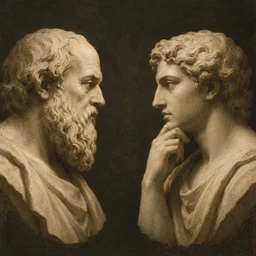
For our last movie night we watched Princess Mononoke. I remembered loving that movie when I was younger, but watching it as an adult made me once again realize how Miyazaki has a way of expressing diverging sides without picking one. The film shows people, animals and spirits with legitimate and largely incompatible needs, and each faction is further engaged in infighting. A central arc of the story is Lady Eboshi’s Irontown, which gives people who were largely rejected by society work, protection and dignity. She gives shelter and work to those who have leprosy and to former sex workers. The mine and the weapon factory provide them with a livelihood, but they also destroy the forest around them. The forest’s inhabitants, in particular the boars, response choose war against the humans to defend themselves. Eboshi is not portrayed as a villain. She does real good for the people of Irontown, but also is an arms manufacturer who is destroying the forest around it. The film anchors around a character called Ashitaka, who has been condemned to death by an unfortunate encounter with a god that was turned into a demon after being fatally wounded by one of Eboshi’s guns. He doesn’t take sides, but he wants to understand and find the truth. Another character is San (whom they call Mononoke), a girl who was raised by wolves and, despite being human, considers herself part of the forest. This movie’s backdrop is human progress, and it reminded me so much of the challenges we are facing today with AI. AI is useful, empowering and consequential beyond the people who benefit from it. It’s similar to the iron in the story. Irontown gives the outcast purpose and power. There are people today who see themselves in an environment just like that: people who were never let in before and…

Hide your slop PR descriptions behind

Most of the changes I make to my projects these days come in the form of PRs opened for me by Claude Code or Codex. The PR is my unit of work - I use them to bundle commits together, iterating on them until a feature is complete, document decisions and then merge the finished result. Today's coding agents are great at writing PR descriptions. They're too good at describing the work The problem is that they are too good. An agent-written PR description is accurate and comprehensive. It describes the problem, the detailed solution, and the steps taken to verify it. That's a lot of information to absorb. It's not necessarily slop, but it reads like slop! It's very easy to spot an AI-written PR, and as with other forms of AI writing my instant reaction is best summarized as "I'm not reading all of that". It doesn't matter how accurate or useful the information is, I'm instantly put off by the thought that it will take me longer to read than it took the driving author to write... even when that driving author is me! I want human editorial judgement. I want someone to have thought just long enough about the PR to give me a human-approved introduction that helps me understand, at a high level, what the PR is for and whether it deserves more of my attention. I think I've found a low-effort way to do this that feels right. Hide most of it in a details/summary The HTML <details><summary> elements render as a collapsed heading (the summary) that can be expanded to view the larger piece of text. The code looks like this: <details> <summary>Claude Opus 5.5</summary> <h2>The hook</h2> Plugins implement <code>registeragentreferencetypes(datasette)</code>... </details> When rendered, it looks like this: Crucially, <details><summary> is supported in GitHub Markdown. You can drop those…

What I learned about power from LBJ and Robert Moses

Thanks to Max Farrens, who paired with me in writing the script for this video essay. I recently interviewed Robert Caro. He’s spent the last 50 years writing a four volume biography of Lyndon Johnson, and he spent another 7 years before that writing the biography of Robert Moses, the master builder of New York. His books are widely regarded as the best explorations of political power that have ever been written. They also happen to be literally my favorite books ever. Whenever I meet somebody new, one of the first questions they ask me is, “Who is it that you most want to interview that you haven’t yet?” And for six years, I’ve answered the question the same way: Robert Caro. I’ve spent so much time trying to make this interview happen: chasing his agent, calling his publisher, contacting the museums that have his archives, and even sending him handwritten letters. I finally got to sit down with him, and I’m very happy with how it turned out. It’ll be out this Friday. In the meantime, as I was preparing for the interview, and rereading these biographies, I wrote down the lessons they laid out about how to accumulate and use power. Robert Moses Robert Moses was the master builder of New York. He built more of the physical city than anyone before or since: the Triborough and Verrazano bridges, the Cross Bronx Expressway, Jones Beach, Lincoln Center, Shea Stadium, two giant power dams upstate, in addition to hundreds of parks and dozens of pools. Of the 899 miles of highways completed in New York State by 1964, Moses had built 672 of them. His projects collectively cost hundreds of billions of dollars in today’s money. For more than 30 years, Robert Moses was the most powerful person in New York (more powerful than any elected mayor or governor, despite not being elected…

Joy & Curiosity #103

… and we’re back! I spent the last two weeks travelling. First a week in New York City, then a week in San Francisco. I did many things in those two weeks, but not a lot of reading or writing, which is why you didn’t hear from me. But now I’m back! So, without further ado this week (my daughter is waiting for me to build a Lego truck), here’s a bag of links. We recorded a new episode of Raising An Agent, in person, in San Francisco. I think it turned out great. In fact, I said somewhere else that this might be the most important episode we’ve recorded this year. It’s about nothing less than the company of the future. Highly recommend watching this if you’re in any way curious about how Amp — the team, the company — operates. While in New York, we visited a large customer of ours, an investment bank. I gave a talk there about how I use Amp and what I think have been the biggest 10x multipliers when working with agents. In San Francisco I then recorded the talk and it’s been received very well, so here it is: How I Use Amp. Adam Mastroianni is truly one of the best in the game right now. Everything he puts out is incredibly good. This newest one, Claude, don’t touch my lump, is no exception. It might be the most convincing argument for why AI won’t lead to unemployment I’ve read so far. The only counter-argument I can see is that, well, there will be jobs in the long term, but what about in the next five years? “I’m 38. If You’re in Your 20’s or 30’s, Read This.” I’m also 38 and when I first saw this title I went “ugh”, because hey, feels like I’m only just starting. But it’s surprisingly good, even though it’s a bit Buzzfeed-y. Maybe because it quotes the life-changing Jason Pargin post? PhotoCraft: An open-source, photo editor written by scratch in pure Rust. I saved…

Why Global Trepanation?

A friend asked me to investigate the following mystery: why do 5-10% of skulls from 10,000 BC to 3,000 BC, all over the world, have holes in them? Why do bone growth patterns indicate that most skull-hole-havers survived years after their holes were drilled, even though brain surgery today requires careful sterilization (and frequently, prophylactic antibiotics) to prevent fatal infections? And why did everyone stop doing this sometime around the beginning of recorded history? Was it cultural diffusion? No. Trepanation (the technical term for drilling a hole in the skull) was common across Europe and South America, with scattered cases in Africa and other continents. The Old and New Worlds had limited contact after about 10,000 BC, and most customs don’t survive for five thousand plus years with no reason. Was it good medicine? Sort of, but not in a way that entirely solves the mystery. Trepanation is an effective treatment for epidural hematoma: a patient ruptures a blood vessel in their skull, filling the cranial cavity with blood, and the pressure rises so high that it squashes various vital blood vessels and brain regions, killing the patient. Drilling a hole in the skull releases the blood, relieves the pressure, and saves the patient’s life. This is great, but these kinds of hematomas are very rare today: about 1/100,000 per year. So how do you get 5-10% of people trepanned? I think there are two reasons. First, prehistory was very violent. People were frequently hunting ferocious animals and murdering their friends in tribal quarrels. Epidural hematoma is 1/100,000 in our modern society where people almost never hit their next-door neighbors with flint axes. In a prehistoric culture where people hit their next-door neighbors with flint axes all the time, you…